Counting mole-rat mammaries and hungry pups, biologists explain why naked rodents break the rules
By H. Roger Segelken
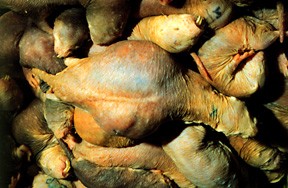
The breeding female 'queen' in an insect-like colony of naked mole-rats frequently produces litters of 20 pups at a time, and one had more than 900 in her 12-year lifetime.
Only hungry babies and grown-up biologists worry whether there are enough mammary glands to go around.
Naked mole-rat mothers don't worry. Even when a female produces more than two dozen pups and has "only" a dozen mammary glands to feed them, naked mole-rat society has a way of keeping peace in the underground nests, according to the cover-story article in the August 1999 Journal of Mammalogy by Paul W. Sherman, Stanton Braude and Jennifer U.M. Jarvis.
"These animals break all our rules," says Sherman, a professor of animal behavior at Cornell University. "Mammals are just not supposed to have so many more babies than mammae," he says, using the Latin for "mammaries." "Most mammals follow the one-half rule. That is, they produce about one-half as many young in each litter as they have mammae. In general, females have enough mammae for each young in the largest litters to have his or her own. It even works for humans, where our average litter size is one, but twins sometimes occur."
Nobody told naked mole-rats about the biologists' long-standing rule, however. Breeding female mole-rats have an average of 12 mammae (See "An Odd Number of Mole-rat Facts," below) and as many as 28 pups at a time.
Yet, there are no tantrums in the African burrows where naked mole-rats come from or in the popular zoo exhibits where most in the United States now live. (The newest opened this month in Syracuse's Burnet Park Zoo.)
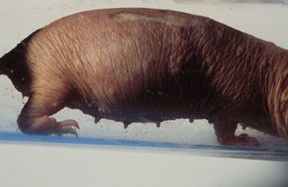
Pups in a naked mole-rat's litter may outnumber available mammary glands, but pups learn to share and the nursing mother's needs are tended to by helpers in the substerranean colonies.
"This disparity had us puzzled," says Sherman, who maintains six laboratory colonies of the highly social and cooperative rodents at Cornell. "We watched their nursing behavior and realized what's going on. They share. The young take turns nursing from the same mammary. There are no fights, and there's plenty of milk to go around."
No food fights among baby mole-rats, that is.
But vicious fights-to-the-death periodically occur among mole-rat females that are vying to become the colony's only breeding female, or "queen." The largest combatant usually wins the honor of producing all the babies for the colony and being attended to, in insect-like cooperative fashion, by all the other colony members. That quirk in naked mole-rat society also helps explain the equanimity at feeding time, Sherman says.
"The queen is larger to begin with, and she is kept very safe and healthy by her colony mates," Sherman says. "She is able to concentrate all her physiological resources on those huge litters, on gestation and lactation. And she is able to spend plenty of time with her pups.
"This is one more reason why Heterocephalus glaber (naked mole-rats) are so interesting to biologists," Sherman says. "They live like social insects, the adults share food and defense tasks, they have the largest litters of any known mammal, they are closely related, and now, it appears, the young are willing to share mother's milk. These animals have evolved to break the rules, because of their extreme sociality."
But why not have 28 mammae, one for each pup? The biologists think that would cause more harm than good. "We hypothesize that larger numbers of mammary glands would incur increased costs, due to infections (such as mastitis) and mammary cancer," Sherman says. "Since the pups will share, and since their mother can spend enough time with them to feed every one, there is no necessity to have a mammary for every pup."
The study was supported, in part, by the National Science Foundation of the United States, the South African Research Council and the Alfred Sloan Foundation. Braude is an assistant professor of biology at Washington University in St. Louis and the International Center for Tropical Ecology. Jarvis is a professor of biology at the University of Cape Town, South Africa. Sherman is the author of more than a dozen papers and several books about H. glaber, including Biology of the Naked Mole-rat. The Journal of Mammalogy article is titled "Litter Sizes and Mammary Numbers of Naked Mole-rats: Breaking the One-half Rule."
An Odd Number of Naked Mole-rat Facts
Source: Division of Neurobiology and Behavior, Cornell University
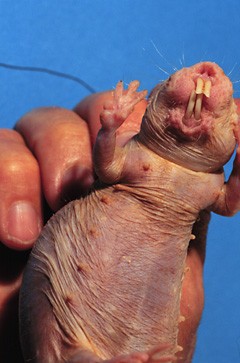
A breeding female from a Cornell laboratory colony of naked mole-rats offers proof that biologists' "one-half rule" for mammary glands does not apply to all mammals. Unlike humans and most other mammals, nursing naked mole-rats often have many more pups than mammary glands.
- MISNAMED MAMMAL. Naked mole-rats (Heterocephalus glaber) are neither moles nor rats. Like rats, they are rodents, but they're more closely related to porcupines and chinchillas. And they're not totally naked. They have fine hairs over most of their bodies, with concentrations on their heads, tails and between their toes. Thirty-seven species of rodents worldwide are called mole-rats because they burrow underground and have rat-like teeth and tails; all except H. glaber (which means "different-headed smooth") have fur.
- SUPER MOMS. It's a good thing naked mole-rat kids don't need haircuts, because mole-rat mothers have an awful lot of them. Litters of more than 20 at a time are not uncommon, and the average is 11 pups per litter. One naked mole-rat queen, as the breeding females are called, produced more than 900 pups in her 12-year lifetime at a laboratory colony. No other mammalian female consistently has such huge litters.
- RULE-BREAKERS. Naked mole-rats are the exception to biologists' one-half rule, which describes the fact that mammals have half as many babies, on average, as they have mammary glands. H. glaber breeding females average 12 mammary glands to feed their 11-16 young, and an odd number of mammaries -- nine, 11 or 13 -- occurs frequently.
- ODD ARRANGEMENT. An odd number of mammaries leads to an asymmetrical arrangement on the mole-rats' bodies -- five mammaries on one side and six on the other, for example -- and another "problem" for biologists. Among most organisms, bilateral symmetry is the rule. Usually, an organism's left side is a mirror image of the right, and numerical asymmetry is thought to be a dysfunctional result of a genetic disrupter during development. Such a genetic disrupter could be a mutation that is spread by extreme inbreeding among populations or perhaps a result of environmental factors, such as pollution, pathogens or plant toxins. In some species, morphologically symmetrical individuals grow faster, live longer and have greater reproductive success than asymmetrical individuals. Again, naked mole-rats are the exception: Some mole-rat populations are extremely inbred. Yet, symmetrical and asymmetrical mole-rats are just as likely to become successful breeders. And asymmetrical breeding females actually bear slightly larger litters than do symmetrical females.
- ANOTHER BAD AIR DAY. In the wild, naked mole-rat burrows are sealed except during excavation, so fresh air is scarce and the carbon dioxide level would suffocate most animals. The gerbil-sized H. glaber compensates for the lack of oxygen with a metabolic rate less than half that of other rodents and with highly efficient hemoglobin that effectively captures oxygen for the bloodstream.
Media Contact
Get Cornell news delivered right to your inbox.
Subscribe