At Cornell, groundhog is harbinger of health
By Roger Segelken
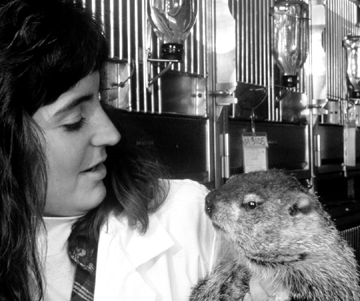
Every Feb. 2 has a special significance for researchers at Cornell's College of Vet erinary Medicine, and it's not because scientists think a sleepy rodent on Groundhog Day can predict winter's end.
Rather, the groundhog (also known as the woodchuck) is honored at Cornell for its indispensable contributions to the study of liver disease in humans. For more than 15 years, animals born at the world's only scientific source of disease-free woodchucks have led researchers to discoveries in treatment and prevention of hepatitis B infection and the liver cancer it can cause.
"A percentage of the wild woodchuck population in the United States is infected with a virus very similar to HBV, the human hepatitis B virus. Humans don't get hepatitis from woodchucks with WHV, the woodchuck hepatitis virus, but the virus and its effect on their liver is similar enough to make the woodchuck the best system we have for studying viral hepatitis in humans," explained Bud C. Tennant, D.V.M., the James Law Professor of Comparative Medicine who heads the woodchuck research project.
Groundhogs in the Cornell program have been responsible for many advances in understanding liver disease (see accompanying chart), including the finding that immunizing against hepatitis B virus can prevent liver cancer. Woodchucks are the best-available animal model for hepatitis B studies, Tennant said, because the woodchuck virus has a nearly identical effect on woodchuck livers as does human hepatitis B virus on human livers -- except that time is compressed. Disease processes that take 30 to 40 years in humans occur in three to four years in woodchucks. The only other animal model for HBV studies is the chimpanzee, an endangered species.
An estimated 250 to 300 million people, mainly in sub-Saharan Africa and Asia, are carriers of HBV, and about 40 percent of those infected will develop chronic liver damage or cancer. Many babies are born infected with the virus in those regions of the world, and they carry the infection throughout their lives.
Most of the woodchuck studies are conducted at Cornell, in collaboration with re searchers from the National Institutes of Health and from research centers supported by the NIH. The original woodchucks that formed the breeding stock for the Cornell colony were caught in the wilds of upstate New York, beginning in 1979.
Cornell raises the woodchucks indoors, under contract with the NIH, so the disease-free animals are essentially government employees. They must be considered "essential" because they continued to work and receive their pay -- in woodchuck chow -- during the recent federal government furloughs.
Besides a reliable source of food, shelter and veterinary care, the Cornell groundhogs have one advantage that their outdoor cousins do not: an unfailing knack for predicting weather. Even the most celebrated of wild groundhogs -- which folklore credits with indicating another six weeks of winter if they see their shadow on Groundhog Day -- are frequently and disappointingly wrong.
But not Shadow, the Cornell woodchuck colony mascot.
"By the time Shadow wakes up and comes out of her nestbox on Feb. 2, the indoor lights are on," Tennant revealed. "Not surprisingly, she always sees her shadow.
"And we're never surprised if spring is months away," he said. "After all, this is Ithaca and upstate New York."
==========================
Highlights of CU woodchuck research
Cornell research involving woodchucks has resulted in many advances in understanding liver disease. Among them:
- Proof that hepatitis B virus infection is the proximate cause of liver cancer.
- Demonstration that immunization against hepatitis B virus can prevent liver cancer.
- Confirmation that immunosuppressant drugs used for human liver transplants increase viral replication of HBV, leading to the loss of the transplanted liver.
Research now under way with woodchucks is expected to yield even more benefits. Among them:
- Determining the role of dietary factors in liver cancer, such as alcohol or the aflatoxins found in some cereal grains and peanuts.
- Identifying the viral genetic factors responsible for chronic infection by hepatitis B virus, an important step because the highest occurrence of liver cancer is seen in chronic carriers of the virus.
- Discovering, on the molecular level, exactly how the virus causes liver cancer, as well as how the viral genes responsible for replication of the virus function; interruption of the replication genes could be the best anti-viral strategy, some experts believe.
- Testing new and improved hepatitis B vaccines.
Media Contact
Get Cornell news delivered right to your inbox.
Subscribe