Possible computer data storage system smaller than a dot on this page is described by Cornell University researchers
By Bill Steele
ATLANTA -- Researchers at Cornell University are testing devices that could form the basis for a potential ultrasmall computer data storage system that could gather up to 100 times as much information in the same space as present-day magnetic data disks. An array of the devices that make up the system is considerably smaller than the period at the end of this sentence.
Cornell postdoctoral associate Stephane Evoy and graduate students Lidija Sekaric and Dustin Carr described their work March 23 at the 1999 centennial meeting of the American Physical Society at the Georgia World Congress Center. They are part of a research group working under Harold Craighead, Cornell professor of applied and engineering physics, and Jeevak Parpia, Cornell professor of physics.
The devices are "nanomagnets"-- tiny bar magnets as small as 25 nanometers (nm) long. A nanometer is one billionth of a meter. Such nanomagnets are being considered by several research groups as potential candidates for future magnetic storage applications. However, to make a system based on nanomagnets work, designers have to learn some new physics.
Magnets less than about 100 nm wide have a unique property, Evoy said. When magnetized, each one forms a single magnetic "domain." That is, the magnetic fields of all the atoms in the magnet are perfectly aligned. In larger magnets, like the ones used to stick recipes to refrigerator doors, there are many smaller domains, or groups of atoms, aligned in various directions; the behavior of the magnet depends on how the majority of the domains are oriented.
Single-domain magnets, Evoy explained, could be used for data storage: A magnet could represent a one or a zero depending on which way its north and south poles pointed. The polarity could be changed by applying a magnetic field. But practical applications are still in the future. "We're not looking at the mechanisms for reading and writing to these devices as other groups are already addressing such issues," Evoy said. "What we need is to understand the physics of small magnets."
At the Cornell Nanofabrication Facility, the researchers deposited rows of tiny cobalt dots on silicon surfaces using techniques originally designed to make electronic circuits. In various experiments they created dots ranging from 25 nm to 100 nm wide, in several different arrangements. Most are about 80 nm wide, 140 nm long and about 20 nm thick.
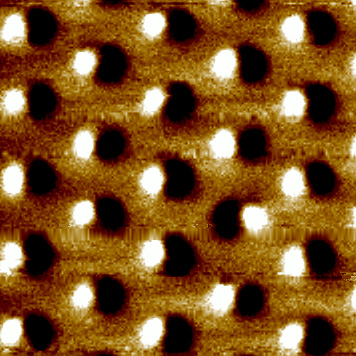
The researchers have been able to read the orientation of individual magnets -- slowly -- using a magnetic force microscope (MFM). This is a device with a tiny tip suspended just above the surface to be examined. The tip is coated with a magnetic material and is scanned back and forth across the surface. The instrument records any magnetic interaction between the tip and the surface, forming a map of the distribution of magnetic fields.
In most experiments, the Cornell researchers apply a magnetic field to an entire array, then measure the states of the individual magnets with the MFM. They have found that there is a great deal of interaction between the tiny magnets. Sometimes, a whole row will line up one way, with adjacent rows in the opposite orientation. Sometimes changing the polarity of a single magnet will affect other magnets in its immediate vicinity, in all directions. This is particularly true when the spacing between the magnets is less than 400 nm, Evoy said.
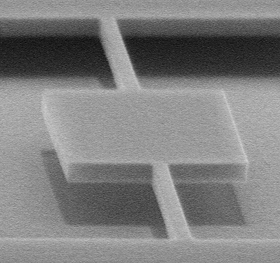
To study the magnetic properties of large arrays of these nanomagnets, and the properties of silicon itself, Sekaric and Carr have built silicon oscillators consisting of small paddles about two to five microns wide, suspended at the ends by rods 50 nm to 100 nm thick. By applying an alternating-current electric field the researchers can cause the suspended surfaces to oscillate, something like a hammock in a high wind. With arrays of nanomagnets deposited on the paddles they will apply an external magnetic field and look for any change of the behavior of the paddle, which will give them information about the magnetic properties of the nanomagnet array.
The approach used to make these tiny oscillators could be used to make very sensitive magnetometers for the study of other magnetic systems, Sekaric said.
Media Contact
Get Cornell news delivered right to your inbox.
Subscribe