Workers more productive when using adjustable tables
By Susan S. Lang
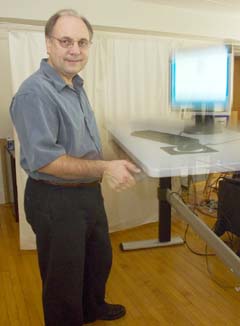
Four out of five people prefer to work at electric, adjustable computer stations that allow them to stand at their computers part of the day, according to a new Cornell study. The study also found that people with access to electrically adjustable tables choose to stand at their computers about 20 percent of the day.
"We found that the computer workers who had access to the adjustable work surfaces also reported significantly less musculoskeletal upper-body discomfort, lower afternoon discomfort scores and significantly more productivity," said Alan Hedge, professor of design and environmental analysis in the College of Human Ecology at Cornell and director of Cornell's Human Factors and Ergonomics Laboratory.
Hedge conducted a study of 33 computer workers at two companies, a high-technology facility on the West Coast and an insurance company in the Midwest. All participants were intensive computer users and filled out questionnaires before the test period about their work patterns and musculoskeletal discomfort at work. At both companies, half the participants randomly received an electric height-adjustable work surface (EHAW) for a month and then both the control and EHAW groups were resurveyed.
"More than 80 percent of the participants preferred the EHAW," Hedge said, "and the average musculoskeletal discomfort index score was 20 percent lower for the EHAW than the fixed-height stations." Hedge noted that the EHAWs were particularly popular with those with neck and shoulder problems.
Hedge reported his findings at the 48th Human Factors and Ergonomics Society (HFES) annual meeting, held Sept. 20-24 in New Orleans. The study is published in the proceedings of the meeting, and a full report is available at http://ergo.human.cornell.edu/CUEHADownRep0904.html.
"An EHAW can be helpful to anyone with a back injury who needs to stand for back relief for part of the day and also for anyone who wishes to work in sitting or standing arrangements," Hedge said. "A subsequent laboratory study that we have just completed that will be presented at next year's HFES conference shows that putting a negative-tilt keyboard tray on an EHAW really works well to keep people's wrists in a neutral posture for intensive keyboard/mouse work."
EHAWs are commonly used throughout Europe and in Australia, Hedge added. They tend to cost from $800 to $2,000, depending on whether the table is angled and includes a separate, adjustable negative-tilt keyboard tray.
Also at this year's HFES meeting, Hedge was made a fellow of the Human Factors and Ergonomics Society. Since the society was founded almost 50 years ago, fewer than 250 of Hedge's colleagues have become fellows.
Hedge also is the co-editor of the new book Handbook of Human Factors and Ergonomics Methods (CRC Press), which presents an overview of 83 major methods in ergonomics and human factors. It covers a wide range of human factors and ergonomics in systems analysis, design and evaluation, and discusses advantages, disadvantages, examples, related methods and more.
The handbook, Hedge says, provides a representative range of contemporary methods that are valuable in ergonomic analyses and evaluations.
The EHAW field study was made possible in part by a corporate gift from Linak, a designer and manufacturer of electric actuators and control systems, and by a donation of work surfaces and their installation at the sites for the study from WorkRite Ergonomics. The laboratory study was supported in part by a corporate gift from Humanscale, N.Y., a manufacturer of ergonomic products.
Media Contact
Get Cornell news delivered right to your inbox.
Subscribe