Environmentally conscious agricultural practices by U.S. farmers would ease drain on world water supply
By H. Roger Segelken
In a world plagued by shortages of water, three facts stand out in an analysis by Cornell University ecologists: Less than 1 percent of water on the planet is fresh water; agriculture in the United States consumes 80 percent of the available fresh water each year; and 60 percent of U.S. water intended for crop irrigation never reaches the crops.
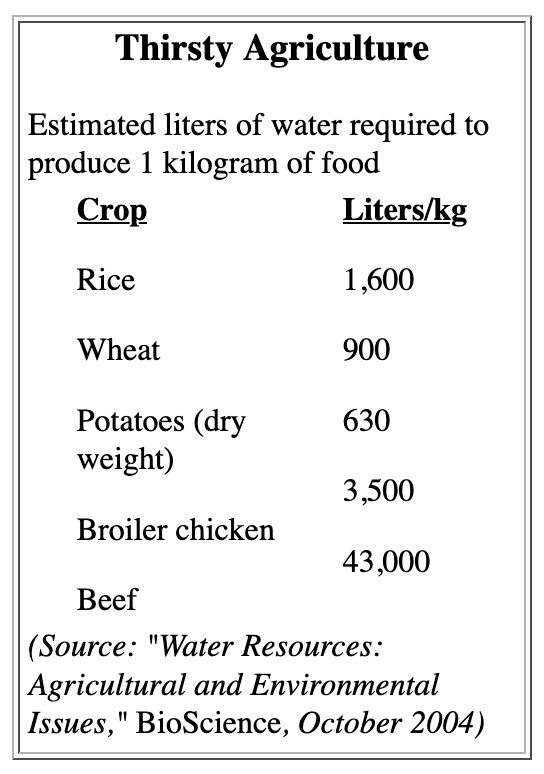
Their report in the October 2004 journal BioScience (Vol. 54, No. 10, "Water Resources: Agricultural and Environmental Issues") names farmers as "the prime target for incentives to conserve water." The report is particularly critical of irrigation practices in the United States, where subsidized "cheap water" offers scant incentive for conservation.
"Part of the problem is the decision by farmers on what to grow where," says David Pimentel, a Cornell professor who led nine student ecologists through an exhaustive analysis of research conducted at other institutions and government agencies. "We learned, for example, that to produce wheat using irrigation requires three times more fossil energy than producing the same quantity of rain-fed wheat. The next time you make a sandwich, think about this: One pound of bread requires 250 gallons of water to produce the grains that go into the bread."
At particular risk, the ecologists discovered, are aquifers, the once-vast but now diminishing underground repositories of water that are tapped by wells for agricultural irrigation and drinking water. "Given that many aquifers are being over-drafted, government efforts are needed to limit the pumping to sustainable withdrawal levels . . . Integrated water resource management programs offer many opportunities to conserve water resources for everyone, farmers and the public," they write in their report in BioScience, a publication of the American Institute of Biological Sciences.
Their report concludes with a six-point priority list for using water wisely:
- Farmers should be the prime target for incentives to conserve water.
- Water-conserving irrigation practices, like drip irrigation, should be implemented to reduce water waste.
- Water- and soil-conservation practices, like cover crops and crop rotations, should be implemented to minimize rapid water runoff related to soil erosion.
- Water subsidies that encourage the wasteful use of water by farmers and others should be eliminated.
- Forests, wetlands and natural resources should be protected to enhance the conservation of water.
- Water pollution needs to be controlled to protect public health, agriculture and the environment.
Other authors of theBioScience report were students in Pimentel's graduate-level class, Environmental Policy: Bonnie Berger, David Filiberto, Michelle Newton, Benjamin Wolfe, Elizabeth Karabinakis, Steven Clark, Elaine Poon, Elizabeth Abbett and Sudha Nandagopal.
Media Contact
Get Cornell news delivered right to your inbox.
Subscribe