Meanwhile, back in the lab: World's most advanced sound-detection tools aided human ears
By Roger Segelken
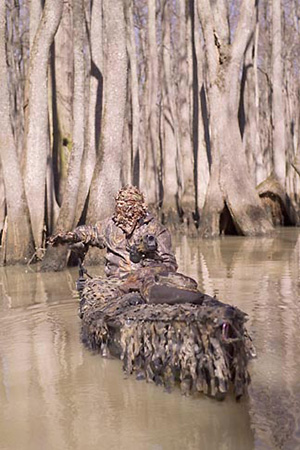
ITHACA, N.Y. -- In the bayous of Arkansas, as in other forested habitats, birds are often heard before they're seen. Recorded sounds of Campephilus principalis -- and not something else that sounds almost alike -- can be high-tech "bread crumbs," according to Russ Charif.
The biologist in the Cornell Lab of Ornithology's Bioacoustics Research Program, source of some of the world's most advanced natural-sounds recording and analysis tools, explained: "Think of these recorded sounds -- the signature double rap of the ivory-bill or its 'kent' call -- as bread crumbs leading a camouflaged photographer to the base of the tree for that once-in-a-lifetime photo."
Across the room in the bioacoustics lab, earphone-clad analysts watched intently as sound spectrograms -- visual representations of sounds -- scrolled across computer monitors. They paused every few seconds to listen to an "event" that the sound-analysis software had highlighted from thousands of hours of recordings.
Was that really the "kent" of the ivory-billed woodpecker? Or just a nuthatch, or even a snow goose, with a similar vocalization? Back in 1831, the ivory-bill's nasal sound reminded John James Audubon of "a high, false note on a clarinet." One 21st-century birder said an ivory-bill sounds "like a nuthatch on steroids."
Play it again: Was that the ivory-bill's "BAM-bam!" double knock? Nine other Campephilus species rap twice on wood to make their long-distance communication signal, but those woodpeckers all live in Central and South America. Was this the "BAM-bam!" that would finally lead searchers to North America's most elusive bird? Or just another gunshot?
Whatever the source, the sounds first had to be recorded:
- The sound recording-and-analysis process began in the field with devices called ARUs, for autonomous recording units. A compact block of electronics gear about the size of a palm-held computer included a small hard drive and the circuitry to start and stop recording -- typically about four hours when ivory-bills awoke in the morning and four hours before they retired in the evening -- plus a processor for digital signals. The gear was concealed in a 2-foot-long piece of PVC plumbing pipe.
- Outside the pipe, a furry "wind sock" covered the 16-microphone array to filter some ambient noise, although plenty of non-bird sounds -- distant train whistles and too-close-for-comfort gunshots, for example -- became part of the recordings.
- Two 6-volt lantern batteries powered the unit for each weeklong recording session. Then a technician returned by canoe to retrieve the ARU and download the recording to a larger hard drive, which were shipped back to Ithaca for analysis. Equipped with fresh batteries, the ARU was then moved to another location.
- The ARUs were strapped to trees -- safely above water level, it was hoped, although periodic flooding could change water levels in the search area 10 feet or more in a month.
- To survey the 160,000-acre search site, ARUs were moved frequently and spaced as far apart as possible. The bird's "kent" call could be recorded up to 200 meters away, while the double-rap sound carried about 300 meters. If one unit detected a promising sound, others could be moved nearby to "triangulate" the source.
- The ARU was invented at the Cornell Bioacoustics Research Program and has been used to record everything from right whales in the North Atlantic to Africa's forest elephants. The 2002 search for the ivory-bill in Louisiana's Pearl River Wildlife Management Area used 12 ARUs. The 2004-05 Arkansas search across a larger area required 24 ARUs.
In deciding where to deploy the recording units, the Cornell surveyors said they tried to think like a hungry ivory-bill or an egg-laying beetle, asking themselves: Where are the dying trees with beetle larvae under the bark, where a woodpecker might feed? They used infrared aerial photography to find what they called "pink [in infrared rendition] bathtub rings" of stressed trees around pools of water. If beetle larvae were under the bark of the stressed trees, then maybe -- just maybe -- ivory-billed woodpeckers would find the trees, tear off the bark in a process called scaling and feed.
The surveyors in the field didn't know if their think-like-a-beetle strategy was paying off until the recordings were analyzed in the Ithaca laboratory, and that was a daunting task:
- Recordings from the 2004-05 survey (eight hours a day from each of 24 units) were the equivalent of nearly three years of continuous recording. Even a major university like Cornell couldn't spare enough people to listen to all that sound, so the first part of the detection process was automated.
- Data from the search, when it was finally analyzed and archived, added up to a server-busting 3 or 4 terabytes. All recordings will be saved, even if nothing was found in the first analysis.
- Two Cornell-developed sound visualization and measurement programs, called XBAT and Raven, were used. XBAT (for eXtensible BioAcoustic Tool) rapidly scans the digital recordings and detects sounds similar to those made by ivory-bills. Raven was used for interactive exploration of sounds that are of particular interest.
- On the sound spectrograms, XBAT highlighted sounds of interest with colored boxes to catch the eye of the analyst. The analyst played and replayed each detected event, sometimes comparing the sound to reference recordings of ivory-bills, their close relatives or other species that sound almost alike. As the search neared the midpoint, analysts had already scrutinized 91,000 "detections" and set aside all but a handful.
Archival recordings of ivory-billed woodpeckers were critical to the detection software and the human analysts. Although no record of the ivory-bill's double-rap sound existed until the 2004-05 survey, the bioacoustic scientists have good-quality recordings of vocalizations from the 1935 expedition to Louisiana's Tensas River by Cornell ornithologists Peter Paul Kellogg, Arthur A. Allen, George Sutton and James T. Tanner. On the soundtrack of motion picture film, the 1935 team successfully recorded an adult pair of ivory-bills and their young at the nest. This recording -- the first ever made of the voice of the ivory-bill -- provided the "template" that the detection software attempted to match and guided the decisions of the analysts about which sounds were the most interesting.
"Automation is great," Charif said, "but the real gold standard, in the final analysis, is still the human ear."
Nevertheless, the veteran of earlier bioacoustic searches -- before XBAT and other tools became available -- wanted to save human ears for what they do best. He observed that if the ivory-bill survey relied on human ears alone, those humans would have had to remain attentive through tens of thousands of hours of recordings -- to catch the few seconds that the ivory-bill searchers were looking for. By then, the results would have been too late to be of any real use.
"With XBAT," Charif said, "we enable our trained, expert ears to concentrate on the relatively tiny percentage of the entire data set that really warrants their attention."
Media Contact
Get Cornell news delivered right to your inbox.
Subscribe