Going for the green: Cornell has first "green-certified" buildings in Central New York
By Susan Lang
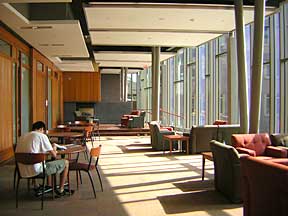
Two new buildings at Cornell University are the first in central New York state and the first residence halls anywhere in the state to earn "green" badges of honor for taking the environment into consideration throughout the entire building process.
The Alice H. Cook House and Becker North, two new residence halls on the university's West Campus, have been granted green-building certification under the U.S. Green Building Council's (USGBC) Leadership in Energy and Environmental Design (LEED ) program. That means they have met the council's stringent standards for having been planned, designed and constructed as environmentally friendly buildings that incorporate sustainable materials, conserve energy and minimize impact on the environment.
Among the many sustainable factors that earned the buildings their certification were:
- using fewer toxic chemicals to clean, part of Campus Life's unique "green housekeeping" program;
- recyclying 50 percent of construction, demolition and land-clearing waste instead of placing it in the landfill;
- using recycled steel and recycling construction waste materials;
- maintaining healthy indoor air during construction;
- using carpet, tile, doors and other products that were "extracted" and manufactured from within the local region and/or that included recycled product content;
- designing spaces to take advantage of natural light and views to the outside environment;
- designing exterior lighting to reduce glare and focus light onto walking surfaces instead of into the sky;
- choosing wood products from managed forests certified by the Forest Stewardship Council;
- providing indoor bike storage and an alternative fuel recharging area for Cornell electric vehicles to encourage transportation alternatives;
- selecting building materials, components, sealants, adhesives, paints and carpets with very low levels of volatile compounds, formaldehyde and similar air contaminants;
- creating effective central cooling with very low energy input and zero refrigerant use via the university's Lake Source Cooling project, thereby avoiding the need for tons of greenhouse and ozone-depleting gases; and
- partnering with Tompkins Consolidated Area Transit on alternative transportation efforts.
Although the North Campus Residential Initiative buildings included many LEED criteria when they were built, the two new buildings on West Campus are the first for which Cornell sought LEED certification. The remaining residence halls and a recreation center under construction on West Campus will incorporate many of the same sustainable strategies used to build Cook House and Becker North. A new Life Sciences Technology Building, which broke ground in May, will not only go for the "green" but also seek the "silver," LEED's next level of sustainability standards.
"In Cornell's first foray into building for sustainability certification, we learned a lot of lessons, so it will now be so much easier to do it right in future buildings," said Steve Beyers, the services team leader for Cornell's Environmental Compliance Office. Beyers also is one of Cornell Facilities' LEED-accredited professionals and the engineer responsible for coordinating West Campus' final application to the USGBC.
Not all upcoming building projects will seek LEED certification, he noted, because doing so incurs extra fees to prepare the proper documentation. However, many building projects will incorporate sustainable design features.
"Planning for every new project includes managing storm water runoff," pointed out Mike MacAnanny, the Campus Life Project Leader for West Campus in the Division of Student and Academic Services. "Recycling and composting facilities are being included in new designs. The forward-thinking Lake Source Cooling project has saved energy and cut down on pollution. I would say the commitment to building with sustainability factors in mind has been very strong and continues to grow."
To encourage the use of appropriate principles of sustainability from this point forward, a new Green Building Oversight Committee has been established at Cornell, co-chaired by Beyers and John Kiefer, director of Planning, Design and Construction at Cornell. Its first meeting takes place the week of July 11.
Media Contact
Get Cornell news delivered right to your inbox.
Subscribe