Apple, biofuel and invasive species programs are some newly funded research and extension projects
By Lauren Chambliss
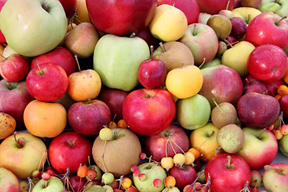
Research projects on biofuels, apples and teaching youths to cook to promote healthy eating are just a few of the 94 new research and extension programs that will be funded this year with more than $1.9 million from the U.S. Department of Agriculture's Cooperative State Research, Education and Extension Service.
The money will be disbursed to new research and extension projects in such diverse areas as human health, food safety, communicating in the Internet age, global climate change, renewable energy and agriculture. They include projects on:
Appropriated by Congress under authority of the federal Hatch, Smith-Lever, McIntire-Stennis and Animal Health acts, these "federal formula funds" go to the Cornell University Agricultural Experiment Station (CUAES), New York State Agricultural Experiment Station in Geneva (NYSAES) and Cornell Cooperative Extension. The annual project awards primarily go to faculty at the Colleges of Agriculture and Life Sciences, Human Ecology and Veterinary Medicine.
The funds, provided yearly to Cornell as a land-grant institution, are a cornerstone of the university's overall research and extension portfolio, says Michael Hoffmann, CUAES director. The new projects will add to the overall portfolio directed by CUAES, NYSAES and CCE of approximately 300 projects, totaling $7.2 million. The federal dollars are even more important than the numbers would imply, he says, because they are frequently leveraged by researchers and extension educators to attract additional funding from other sources.
"We are very pleased to be able to fund such a large percentage -- nearly 80 percent -- of the requests we received," says Hoffmann. "The proposals this year were unusually exciting in that they included cutting-edge issues that are vital to New Yorkers and will make a difference in people's lives."
The awards are determined by a competitive process, starting with priorities set by outside stakeholders from across New York representing community planners, farmers, health and human safety experts, youth coordinators, regulators and CCE executive directors, among others. CUAES directs its research portion of the portfolio with the explicit intention of maximizing positive impact on individuals, families, communities, enterprises, decision makers and the environment, says Hoffmann.
Lauren Chambliss is a communications specialist with Cornell's Agricultural Experiment Station.
Media Contact
Get Cornell news delivered right to your inbox.
Subscribe