Reclusive mathematician rejected honors for solving 100-year-old math problem, but he relied on Cornell's arXiv to publish
By Chris Philipp
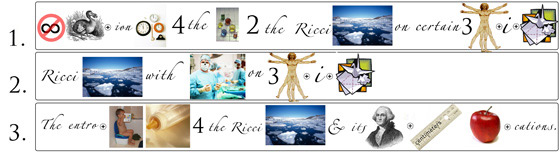
The solution to one of the most famous problems in mathematics was posted on Cornell's arXiv over an eight-month period, beginning in November 2002. Today, arXiv remains its only home.
Most scientists and researchers who post research on arXiv -- an open-access repository for e-print postings operated by Cornell University Library -- also submit it for publication in traditional peer-reviewed journals. But famously reclusive Russian mathematician Grigori Perelman's decision to post his proof of the 100-year-old Poincaré Conjecture solely in arXiv was decidedly unorthodox.

Yet Perelman's action underscores the repository's increasing importance in the fields of physics, math and computer science, and the leading role that Cornell Library is taking in the transformation of scholarly communication, which refers to the ways in which scientists and humanists share ideas.
"What is unusual about this, and certainly for anything this significant, is that Perelman apparently has no intent of publishing in the classical way, but has chosen the arXiv as the sole method of communication," said R. Keith Dennis, a math professor and adviser to the Mathematics Library.
Perelman, who used the nickname Grisha for his postings, was awarded the prestigious Fields Medal last August for solving the Poincaré Conjecture but subsequently turned it down for unknown reasons, saying he was retiring from the field of mathematics. His proof builds on the work of Cornell mathematician Bill Thurston, a Fields Medal recipient in 1982, and uses a program outlined by mathematician Richard Hamilton while he was working at Cornell in the 1980s.
Since Perelman's postings first appeared, several mathematicians have written papers about his work, and some claim to fill in gaps in his proof. One is a 318-page article published in the Asian Journal of Mathematics available through Cornell Library's Project Euclid (see sidebar, below) and also posted in arXiv.
The Poincaré Conjecture is fundamental to topology, a branch of mathematics concerned with spatial properties. It asks whether the same property of simple connectivity that applies to a two-dimensional sphere can be applied to a three-dimensional sphere. Named for French mathematician and theoretical physicist Henri Poincaré, the conjecture is one of the seven Millennium Prize Problems for which the Clay Mathematics Institute is offering a $1 million prize. What will happen with this prize money now that the Poincaré Conjecture is solved has yet to be determined.
"Perelman's choice of arXiv to disseminate his proof is a watershed event in scholarly communications," said Sarah E. Thomas, the Carl A. Kroch University Librarian. "Although Perelman declined the Fields Medal, perhaps, if offered the Clay Mathematics Institute prize for solving the Poincaré Conjecture, he'll donate the million dollars to the arXiv to enable the global community of scholars and scientists to continue to benefit from this transformative resource."
With arXiv, Cornell Library provides fast, free and open access to scientific literature, serving the fields of physics, mathematics, nonlinear science, computer sciences and quantitative biology. An international project with dedicated mirror sites in 17 countries, arXiv has registered users from 150 countries, according to Jean Poland, associate university librarian for the Associated Science and Technology Libraries.
All four recipients of the Fields Medal, which is awarded every four years, are regular arXiv contributors, including Terrence Tao, who is also one of its moderators. There are over 20 million full-text downloads from the server per year, and it currently hosts more than 380,000 articles, with a submission rate of 4,000 per month.
"Everybody reads it," said Paul Ginsparg, Cornell professor of physics and of computing and information science who developed the repository while working at Los Alamos National Laboratory in 1991. "[Perelman] put it there precisely to reach a wide audience."
arXiv moved to Cornell with Ginsparg when he returned as a faculty member in 2001, and it is now a collaboration between the library and Cornell's Information Science Program. Cornell Library is responsible for arXiv's maintenance, while research and development of the repository is handled by information science.
"It is our goal to maintain open access because of its historical and its current value, as illustrated by Perelman's e-print postings," Poland said. "[arXiv] is the first point of dissemination of much of the world's progress in physics, mathematics, computer science and quantitative biology. Beyond maintaining, updating and expanding daily operations, [Cornell Library] is developing a program to preserve [its] form and content for future generations."
arXiv has transformed how material is shared, making science more democratic and allowing for the rapid dissemination of scientific findings. The traditional publication process and refereeing process can sometimes take as long as three years, says David Morrison, a member of arXiv's advisory board, a moderator for the mathematics portion of the repository and a professor of mathematics and physics at Duke University and the University of California-Santa Barbara.
"To me, arXiv is a good way and a timely way to communicate with your colleagues what is happening," said Morrison. "What makes arXiv so great is you can put work out there and it is immediately available."
In addition to arXiv and Project Euclid, Cornell Library has developed other innovative ventures, including DPubs, DSpace and VIVO.
Chris Philipp is a staff writer and editor for Library Communications.
Innovations in scholarly communications from Cornell University Library
Center for Innovative Publishing
The Center for Innovative Publishing is a field station for the design, implementation and effective management of online publishing projects from Cornell and other academic communities, university presses and scholarly societies.
Project Euclid
Project Euclid is an online publishing service that brings together almost 50 journals in mathematics and statistics. The service delivers more than 350,000 articles, of which 70 percent are open access or freely available worldwide.
arXiv
A user-driven service for the efficient online dissemination of research results in physics, mathematics, nonlinear science, computer science and quantitative biology. Currently, arXiv hosts more than 380,000 e-print postings and has an average submission rate of 4,000 papers per month. Posted papers are freely available worldwide.
DSpace
DSpace is an open-source digital institutional repository system that captures, stores, indexes, preserves and redistributes research data. This system is currently used at 100 institutions worldwide.
DPubS
DPubS (Digital Publishing System) is an online publishing system developed by the library and designed for the cost-effective management and distribution of such scholarly publications as journals, conference proceedings and monographs. It provides the underlying infrastructure for Project Euclid and other ventures.
VIVO
VIVO, a virtual life sciences library for the Cornell community, will be expanded over the next two years to include the physical and social sciences and human and animal sciences. It includes faculty listings, databases, image collections, grant information, recent publications and other materials germane to research and scholarship at Cornell. VIVO's goal is to provide an integrated view of the life sciences at Cornell and to connect researchers, whether they are in Ithaca, Geneva, New York City or Doha.
- "Finite extinction time for the solutions to the Ricci flow on certain three-manifolds" (November 2002)
- "Ricci flow with surgery on three-manifolds" (March 2003)
- "The entropy formula for the Ricci flow and its geometric applications" (July 2003)
Media Contact
Get Cornell news delivered right to your inbox.
Subscribe