Cornell's climate plan cuts carbon emissions to zero by 2050, saves millions of dollars
By Krishna Ramanujan
Cornell's new Climate Action Plan, released Sept. 15, will not only make the university far more energy efficient but also could save Cornell hundreds of millions of dollars over the next 40 years.
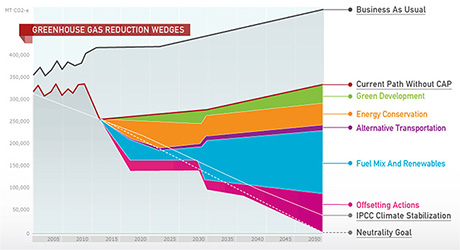
Presented entirely online in a paperless format, the plan seeks to enhance the university's core mission of academics, research and outreach, while cutting net carbon emissions to zero by 2050. The plan includes 19 specific actions across five key areas -- green development, energy conservation, fuel mix and renewable energy, transportation, and carbon offsetting actions.
The plan fulfills the American College and University Presidents Climate Commitment that Cornell President David Skorton signed in 2007, and pledges the university to a path of climate neutrality by 2050, a target year set by Intergovernmental Panel on Climate Change (IPCC) forecasters to reduce carbon dioxide emissions to levels low enough to stabilize climate changes.
"We intentionally designed the plan to stay below global carbon reduction goals for the IPCC," said Dan Roth, sustainability coordinator in the Office of Environmental Compliance and Sustainability. "At the same time, we're potentially going to be saving millions of dollars."
The plan, developed by faculty, students and staff, with technical support from Affiliated Engineers Inc. and funding from the state energy authority, NYSERDA, was endorsed by the Cornell Board of Trustees' Buildings and Properties Committee Sept. 10 and will act as a roadmap for future university decisions.
"It's a plan that is well thought out based on the economic climate we're in," said Kyu Whang, vice president for facilities services and co-chair of the climate implementation committee with Tim Fahey, the Liberty Hyde Bailey Professor of Natural Resources. "Action items will either bear no cost or will have a positive payback to the university," Whang added.
Also, as part of Cornell's land-grant mission, the plan is intended to serve as a model for climate neutrality and economic development for other institutions to act as engines that drive a greener economy, said Roth.
Along with faculty and staff, student leaders have helped develop all phases of the plan. In fact, the student environmental group KyotoNOW! canvassed petitions to initially bring the climate neutrality issue to Skorton's attention.
"Climate change will have the biggest effects on the generation going through the university right now, so it's a big concern to my generation … how we address cutting emissions," said graduate student Michael Walsh, a student trustee who served on the president's climate implementation committee.
Actions across the plan's five key areas include:
- Green development: A 12 percent reduction in carbon emissions will come from improved land use, more effective use of existing building space, and energy standards for new construction that limit energy use to half of industry standard baselines.
- Energy conservation: A 16 percent reduction in emissions is possible through conserving building energy, improving energy-saving practices and upgrading Cornell's electrical grid, partly through externally funded smart-grid research.
- Fuel mix and renewable energy: 42 percent of Cornell's carbon savings could come from upgrading steam-turbine electric generators, using wood instead of coal for boiler fuel and converting from coal to natural gas, among other actions. Cornell's Combined Heat and Power Plant switch to natural gas this winter "will reduce our carbon footprint by 20 percent right off the bat," said Roth. Such renewable energy sources as wind and research-driven biomass-to-energy and geothermal technologies are also in the plan.
- Transportation: Commuter travel programs, teleconferencing, reducing business travel and increasing the fuel efficiency of university-owned vehicles could reduce carbon output by 4 percent.
- Carbon offsetting actions: Cornell's emissions could be cut by 27 percent through converting pastures to forest and better managing forest lands to increase carbon sequestering; fixing carbon through research-driven biochar; and fostering a local community market of carbon credits that could be bought and sold.
Media Contact
Get Cornell news delivered right to your inbox.
Subscribe