Cornell researchers analyzed farmer preferences and found that the softness of cooked cassava is a major influence on what kinds of varieties farmers actually adopt.
Startup Zymtronix – an industrial biotech company housed in Cornell’s McGovern Center – has been selected as a challenge finalist at the Hello Tomorrow 2020 global summit, March 11-13 in Paris.
Nearly 70 professionals from around the world have become Cornell Climate Online Fellows, as they take action locally to battle atmospheric greenhouse gas and ask others to join in.
With the coronavirus spreading in other parts of the world, Cornell has been working with campus partners, as well as local and state resources, to protect the health and well-being of the Cornell community.
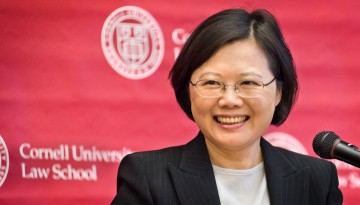
As president of Taiwan, Tsai Ing-wen, LL.M. ’80, has presided over one of the most successful efforts in the world at containing COVID-19. In this Q&A, she discusses her approach to leadership and Taiwan’s success.
Wendy Wolford, Cornell’s vice provost for international affairs and the Robert A. and Ruth E. Polson Professor of Global Development, discusses her background, interdisciplinary approach, the university’s support for students and faculty in international work, the Global Grand Challenge, the new Cornell China Center and more.
Rachel Beatty Riedl, director of the Mario Einaudi Center for International Studies, launched her new book, “From Pews to Politics: Religious Sermons and Political Participation in Africa,” Dec. 11 at the University of Zambia.
Sophie Partington ’21 and Laura DeMassa ’21 have gone from friends in French class to research partners thanks to the Institute for European Studies, part of the Einaudi Center for International Studies.
Cities in the “global south” – densely populated urban areas that are part of low-income countries in Asia, Africa and Latin America – should phase out pit latrines, septic tanks and other on-site methods of human waste management, according to a Cornell researcher.