Ammons' 'lowly and sublime' vision explored at MLA convention
By David Burak
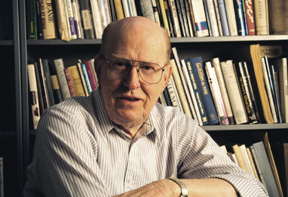
On Saturday, Feb. 18, friends and former colleagues of A.R. "Archie" Ammons don't expect to see his ghost sitting in the Temple of Zeus on the Cornell campus, even though the late Goldwin Smith Professor of Poetry at Cornell would have turned 80 on that day.
However, Ammons' spirit was alive and well in Washington, D.C., during the Modern Language Association convention in December. On the morning of Dec. 28, some of the most treasured parts of Ammons' earthly remains -- his poems -- were brought to life by a cross section of distinguished scholars.
Professor Roger Gilbert of Cornell's English Department organized and moderated the panel, "From 'Ommateum' to 'Bosh and Flapdoodle': Fifty Years of A.R. Ammons." Ammons, who died in 2001 at age 75, had won two National Book Awards, a MacArthur Award and a Bollingen Prize, among other honors.
In his opening remarks on the panel, Gilbert said that "Ommateum," which Ammons paid to have published in 1955, is "now considered one of the rarest books in American poetry." This first collection of Ammons' poetry appeared 100 years after Walt Whitman's "Leaves of Grass," Gilbert said, noting, "Archie was undoubtedly aware that Whitman's seminal work was also self-published, with a preface by the author and with a group of untitled poems." Gilbert said that there's a good possibility that "Ommateum," which now "fetches about $3,000 a copy," will be republished in the foreseeable future.
Steven Cushman, a professor at the University of Virginia, addressed issues arising from a close reading of "The Really Short Poems of A.R. Ammons." In an intense and rapid-fire manner, Cushman contended that Ammons' shorter works are, aesthetically speaking, as legitimate as the poet's longer, more critically acclaimed works, such as "Sphere: The Form of a Motion" and "Tape for the Turn of the Year." Cushman suggested that his perspectives are probably emanations of his "investment ... in seeing Ammons ... as an endlessly capable figure of comprehensive continuity."
"Ammons is a nature poet," declared Elizabeth Mills, a professor at Davidson College. Speaking with a mellifluous Southern accent similar to that of Ammons himself, Mills noted that some of the problems Ammons had with depression and anxiety may have been associated with seasonal affective disorder. Nonetheless, Ammons embarked on his quest to "gather up pieces of clarity." Mills noted that in the period during which Ammons wrote "Lake Effect Country," he said, "I want to deal with intellectual conglomerates that could reveal the nature of things." Mills characterized Ammons as "an edgewalker, a seeker on the periphery."
Kevin McGuirk, a professor at the University of Waterloo, suggested that Ammons' early position in the realm of poets could be understood by looking at him as a type of "outsider artist ... This kind of individual produces work which isn't part of the artistic movements of the time." McGuirk described "Ommateum" as "a very strange book." At the time Ammons published the collection, "most of his peers had Ivy League educations." Ammons did his undergraduate work as a science major at Wake Forest University. He also did a year of graduate work at University of California-Berkeley. McGuirk noted that, before the publication of "Ommateum," Ammons knew virtually no one in the poetry world except Josephine Miles, who had been his teacher at Berkeley.
Professor Steven Schneider, University of Texas-Pan American, concluded by saying that Ammons' poems "continuously explore the inside-out connection and a vision both lowly and sublime ... that enriches us far beyond expectation."
Media Contact
Get Cornell news delivered right to your inbox.
Subscribe