Nobelist David Gross to discuss search for theory of 'fundamental reality' at Bethe lectures
By Lauren Gold
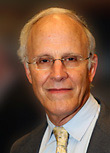
Does string theory hold answers to the biggest dilemmas in physics? Are cosmologists on the brink of a new level of understanding? Is there a Theory of Everything out there, waiting to be discovered?
David J. Gross, the Frederick W. Gluck Professor of Theoretical Physics and director of the Kavli Institute for Theoretical Physics at University of California-Santa Barbara, will offer his thoughts on such lofty questions at the 2006 Hans Bethe Lectures at Cornell, Oct. 16-18.
Gross won the 2004 Nobel Prize in physics (with David Politzer of the California Institute of Technology and Frank Wilczek of the Massachusetts Institute of Technology) for the discovery of asymptotic freedom -- the phenomenon by which quark-quark subatomic particle interactions weaken as quarks approach one another inside atomic nuclei. He will give two department colloquia and a public lecture, all under the sweeping topic "The Search for a Theory of Fundamental Reality."
In a 4 p.m. physics colloquium, Oct. 16, Gross will outline the history of that search -- from the 1911 discovery of the atomic nucleus by Ernest Rutherford through Einstein's quest for the Unified Field Theory in the mid-20th century and, finally, the 1970s experiments that led to Gross' formulation of quantum chromodynamics.
At 4:30 p.m., Oct. 17, he will discuss the Standard Model, the theory of particle physics encompassing the strong force, the weak force and the electromagnetic force; and how the model's inability to explain the fourth fundamental force, gravity, has led scientists to search for a unifying theory. He will discuss string theory, a potential (but so far unproved) answer to the dilemma.
Both colloquia will be in the Schwartz Auditorium of Rockefeller Hall.
In his free public lecture, "The Coming Revolutions," Oct. 18 at 7:30 p.m. in Schwartz, Gross will give an overview of string theory and consider the possibilities for major advances in the near future.
Gross' discovery of asymptotic freedom was a giant step forward in understanding the nuclear force, said Henry Tye, Cornell professor of physics and a member of the selection committee for the Bethe Lectures. "The work is considered the turning point in letting us understand what the nuclear force is made of," said Tye. "It was the last piece, the most difficult piece of all the forces that we know except gravity. So to this day, that's where we are. Our understanding of gravity is still not quite there."
For cosmologists, he added, quantum chromodynamics provides a powerful tool for probing the universe in its earliest moments -- giving them a view back to fractions of a nanosecond after the big bang. "It essentially changed the field," he said.
Gross' recent work in string theory, including his discovery of the heterotic string (a particular description of string theory), has been pivotal in the development of that field.
Gross is also unusual in that his former students include a Nobel laureate and a Fields Medal (for mathematics) winner. "I don't think any other professor has that," said Tye. "That gives you an idea of the breadth of his abilities."
The Bethe lectures, established by the Cornell Department of Physics and the College of Arts and Sciences, honor the late Hans A. Bethe, Cornell professor emeritus of physics, whose research extended across fields as diverse as the quantum theory of solids and the nuclear processes of the sun. Bethe received the Nobel Prize for the latter work in 1967. The lectures have been given annually since 1977.
Media Contact
Get Cornell news delivered right to your inbox.
Subscribe