Two Cornell classes collaborate to create engaging play spaces for adolescents
By Jack Hoge
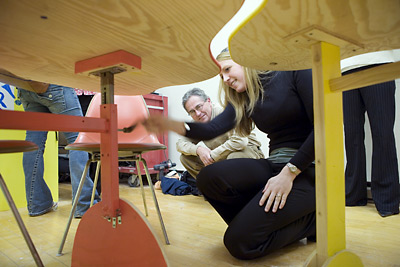
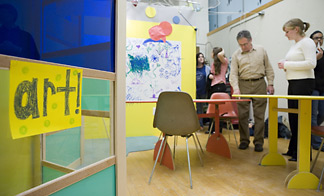
This past semester, teams of students in two College of Human Ecology courses worked together to design functional and appealing activity areas for Boys and Girls Clubs of America: areas for adolescent girls, homework and technology, art and games. The areas would be designed to stimulate at-risk adolescents at the clubs and to give them a feeling of competence.
Beyond just sketches and plans, however, the teams actually built full-scale models and presented them to Boys and Girls Club representatives as well as the children who would use the spaces. The models were presented to interested viewers in Martha Van Rensselaer Hall Nov. 30.
Students from Professor Gary Evans' Environment and Social Behavior class (DEA 250) acted as consultants, using their knowledge of human-environment interaction and social psychology to make recommendations and establish guidelines that would help the design teams, drawn from Professor Paul Eshelman's Intermediate Design class (DEA 301), in making effective interior design choices concerning usability, comfort and levels of supervision.
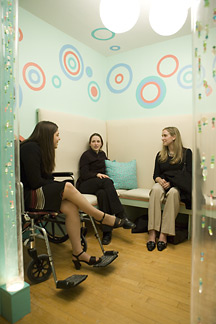
One theme, nicknamed Oasis, offered girls a cozy conversation nook with many pillows and comfortable seating where they could have private conversations. The designers created a room with soothing green walls and an inviting entryway framed by illuminated glass tubes. The enclosed design allowed for privacy, while the open entryway also allowed for easy supervision by the counselors.
In the homework and technology room, portability and easy access to resources was critical. Modular tables in organic shapes were put on rollers and easily could be joined together for group collaboration. Computer tables had easy-to-reach outlets and were height-adjustable. The designers also came up with a dynamic whiteboard made of many sliding pieces that children could move with ease and create personal drawings. For presentations, the pieces could be put back together to function as a projection screen.
The games area design offered a color scheme that would be pleasing to children without being overstimulating. Comfortable chairs and pillows were arranged, as well as a multicolored array of cubbyholes, giving the children a sense of ownership as well as surprises -- half the fun for the children was discovering candies placed at random. Consultants also noted the importance of suitable lighting -- to encourage a warm, inviting environment as well as to reduce television glare.
The consultants' research indicated that many of the children at the Boys and Girls Clubs are at-risk adolescents. For these children, a feeling of competence is especially important. To encourage this, designers created an art room that appealed to many different types of art, including sculpture, painting and digital art.
Jennifer Pendarvis, a senior in the human factors and ergonomics option of DEA and a student in DEA 250, commented, "I really enjoyed it. ... It was interesting to work with the designers. To be able to actually work through that process of doing design guidelines and seeing their design from our guidelines was fun."
The collaborative effort was a great learning experience for everyone involved. "The process of design is almost as interesting as the end result," commented Bridget Sweeney, the graduate teaching assistant for DEA 301. "Working with a real client, having real children come and play in the models is a very valuable experience for the designers and researchers. The Boys and Girls Clubs take away from this many simple, easy to build solutions for their clubs. It is a win-win situation for all."
Jack Hoge '07 is a writer intern with the Cornell Chronicle.
Media Contact
Get Cornell news delivered right to your inbox.
Subscribe