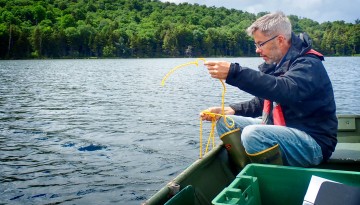
Sturt Manning, Distinguished Professor of Arts and Sciences in Classic, received the P.E. MacAllister Field Archaeology Award at the Annual Meetings of the American Society of Overseas Research, in November in Boston.
The warming of lakes in the Adirondacks, the death of long-time benefactor and alumnus Ratan Tata ’59, B.Arch. ’62, and the retirement of Martha E. Pollack as president were among the most-viewed Chronicle stories of 2024.
The Brooks Tech Policy Institute has received $3 million from the Department of Defense to establish the U.S. Semiconductor Research Hub, which will assess and improve the resilience of the global network of semiconductor infrastructure.
Mimicry appears to be a fundamental behavior that helps people understand each other, not just when they get along, new Cornell psychology research finds.
A Cornell professor’s election forecasting model correctly picked Trump’s win this year in all 50 states – and would have correctly predicted 95% of states in every election since 2000.
In “Piping Hot Bees & Boisterous Buzz-Runners: 20 Mysteries of Honey Bee Behavior Solved,” biologist Thomas Seeley shares some of the findings of his decades’ worth of investigations into honey bee behavior.
During the past century, experimental poets in Japan have been stretching the conventional definition of the genre by creating poems in unexpected places, according to a Cornell researcher.
In “Never On Time, But Always in Time,” Kate McCullough of the College of Arts and Sciences examines four books to explore how queer narratives focus on the body and its senses to find alternative ways of experiencing and presenting time.